A Houston building can have plenty of cooling capacity and still leave people uncomfortable. One office is freezing, another is warm by midafternoon, and humidity makes the entire space feel heavier than the thermostat suggests. That is why the VRF versus rooftop units decision should go beyond equipment tonnage or the first installation quote. The right system must match how your property is used, how it handles moisture, and how much control each area needs.
For a single open retail floor, a well-designed rooftop unit may be the practical choice. For a medical office, restaurant with distinct occupied zones, mixed-use building, or space with varying schedules, VRF may deliver better comfort and operating control. Both can be excellent commercial HVAC solutions when they are properly selected and installed.
VRF Versus Rooftop Units: The Core Difference
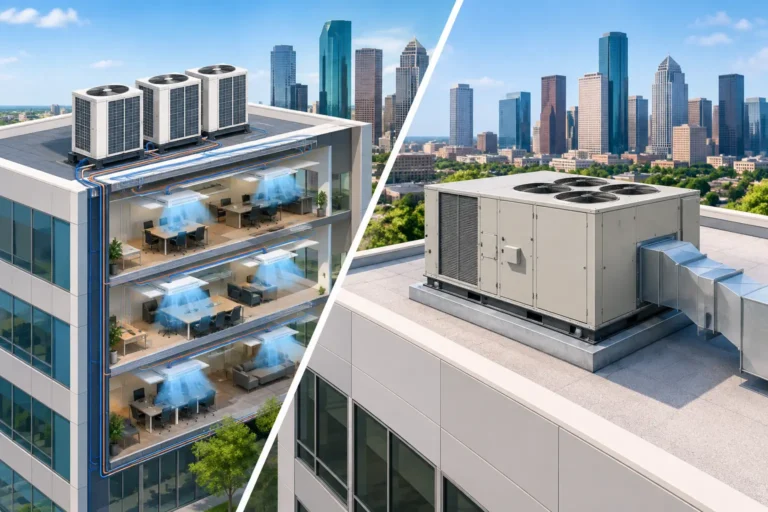
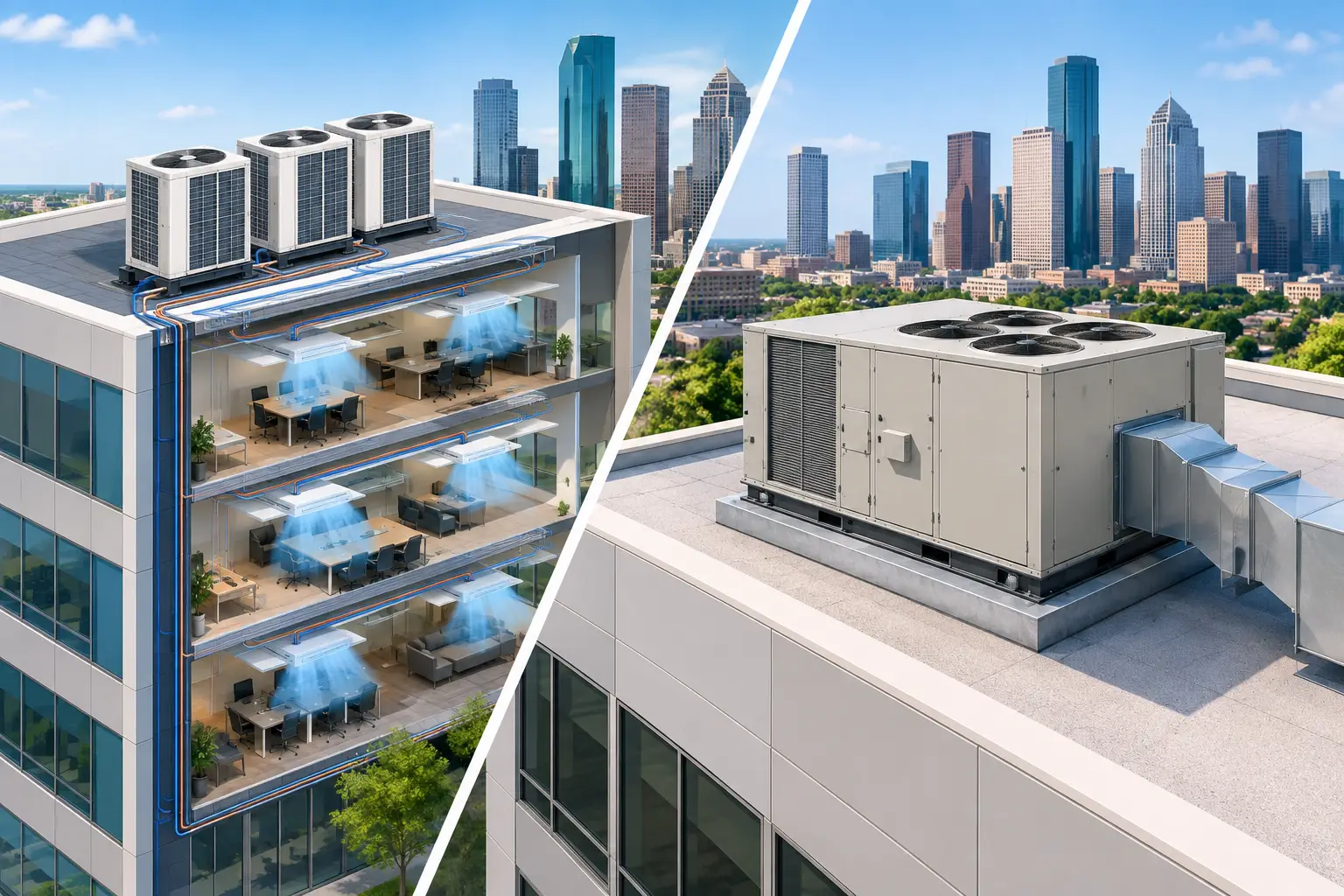
A rooftop unit, often called an RTU, is a packaged heating and cooling system installed on the roof. It typically serves one large area or a defined section of a building through ductwork. The equipment contains its major cooling and heating components in one cabinet, which can make it familiar to service teams and relatively straightforward to replace when an existing building already has rooftop curbs and ducts in place.
A variable refrigerant flow, or VRF, system uses one or more outdoor condensing units connected to multiple indoor units. Each indoor unit can serve a separate zone, such as an office, dining room, conference room, tenant suite, or bedroom. The system varies refrigerant flow to meet changing demand rather than simply cycling at full output.
That distinction changes the experience inside the building. RTUs generally condition larger areas together. VRF systems are built around individual-zone comfort, allowing people in different spaces to set temperatures based on their needs. Some VRF designs can also provide cooling in one zone while heating another, a useful capability in buildings with interior rooms, sun-exposed glass, kitchens, and different occupancy patterns.
Where Rooftop Units Make Sense
Rooftop units remain a dependable choice for many Houston commercial properties. They are particularly effective in open-plan spaces with consistent occupancy and similar temperature needs throughout the day. Warehouses with offices, retail spaces, fitness facilities, small restaurants, and single-tenant buildings may benefit from the familiar layout and broad air distribution of an RTU system.
When a building already has functional ductwork and roof infrastructure, replacing aging rooftop units can also limit construction disruption. A like-for-like replacement may be faster and less invasive than redesigning the entire mechanical system. Modern high-efficiency RTUs can offer staged or variable-speed operation, improved controls, and stronger efficiency than older equipment.
RTUs can also be a sensible answer when ventilation is a major part of the load. Commercial buildings need outdoor air for occupant health, and restaurants often need carefully coordinated make-up air and exhaust systems. A rooftop configuration can be designed to work with those requirements, provided the system is sized for the real sensible and latent load, not just the building square footage.
The trade-off is zone control. If one RTU serves several offices, each office is affected by the same thermostat strategy and airflow balance. Adding zoning can help, but it adds dampers, controls, and design complexity. In a building where each room has dramatically different needs, a central rooftop approach may create ongoing comfort complaints even if the equipment is technically operating as designed.
Why VRF Appeals to Multi-Zone Properties
VRF is often a strong fit when comfort varies room by room. Think of professional offices with perimeter windows, a medical practice with exam rooms, a hotel, a church campus, or a commercial property with multiple tenants. Rather than conditioning every room as if it has the same heat gain, a VRF system can respond to each zone independently.
This control can reduce wasted cooling. An empty conference room does not need the same output as a busy reception area. A west-facing office can receive more cooling in the afternoon without overcooling interior spaces. Indoor units can be selected to fit the room, including ceiling cassettes, concealed ducted units, wall-mounted units, and other configurations suited to the building design.
VRF can also reduce the need for large duct runs. That can be valuable during renovations, tenant build-outs, and projects where ceiling space is limited. Smaller refrigerant piping may be easier to route than new full-size ductwork, although installation still requires careful planning, code compliance, condensate management, controls commissioning, and qualified technicians.
The first cost is often higher than a basic rooftop replacement, especially on larger projects. VRF is also not a shortcut for poor design. Refrigerant line lengths, branch selection, electrical capacity, airflow, condensate drainage, and access for future service all need to be addressed before installation. A system that is selected only for its efficiency rating, without considering the building’s ventilation and humidity needs, can disappoint its owner.
Humidity Control Is a Houston-Specific Priority
Houston air conditioning systems do more than lower temperature. They must remove moisture reliably during long cooling seasons. High indoor humidity can make occupants feel uncomfortable, contribute to odors, and create conditions that are harder on finishes and equipment.
Rooftop units can provide effective dehumidification when they are correctly sized and equipped for the job. Oversized equipment is a common concern because it may cool the space quickly and cycle off before removing enough moisture. Proper airflow, staging, and control settings matter just as much as nominal capacity.
VRF systems are highly efficient at matching sensible cooling demand, but humidity control needs deliberate attention. In some applications, a dedicated outdoor air system or separate dehumidification strategy is the right complement to VRF. That equipment treats the ventilation air and helps manage the moisture brought in from outside, while the VRF indoor units focus on zone temperature and comfort.
This is not an argument against VRF. It is a reminder that Houston projects benefit from a complete HVAC design. The best answer may be VRF with dedicated ventilation, high-efficiency RTUs with zoning, or a hybrid system that uses each technology where it performs best.
Comparing Cost Beyond the Initial Proposal
The installed price matters, but it is only one line in the ownership cost of a commercial HVAC system. Property owners should compare equipment life, expected repair needs, energy use, controls, ventilation upgrades, roof work, electrical work, and the disruption involved in installation.
A rooftop unit may have a lower entry cost when it replaces existing equipment on an existing curb with usable ducts. Service access is usually simple because the major components are together on the roof. However, large ducted systems can lose efficiency through leakage, poor insulation, and uneven airflow. Repairing or modifying rooftop equipment may also require roof access, cranes, and weather coordination.
VRF often costs more upfront but can create value through zoned operation, part-load efficiency, and reduced ductwork in the right building. Because there are multiple indoor units, maintenance is more distributed. Filters, coils, drains, and controls need consistent attention across the system. The quality of the original installation is especially important, since refrigerant piping and controls must be precise for reliable performance.
In either case, utility incentives and financing can change the project economics. Available rebates depend on the equipment, efficiency tier, utility program, and project details. Reviewing those options before selecting equipment can help owners make a stronger long-term investment rather than defaulting to the lowest first cost.
A Practical Way to Choose
The best system starts with a property-specific assessment. Before recommending VRF or rooftop equipment, an experienced HVAC contractor should evaluate the building layout, occupancy schedule, existing ducts, electrical service, ventilation requirements, roof condition, indoor humidity, and future expansion plans.
A rooftop system is often the better fit when the space is open, ductwork is in good condition, zones have similar schedules, and replacement speed is a priority. VRF is often the better fit when the building has many independently used rooms, recurring hot-and-cold complaints, limited duct space, or a need for tenant-level comfort control.
Restaurants require an especially careful review. Dining areas, kitchens, walk-in coolers, exhaust hoods, make-up air, and heat-producing appliances create very different loads. A VRF system may serve the dining room and offices well, while specialized kitchen ventilation and dedicated equipment handle the cooking area. Treating the entire operation as one comfort zone is rarely the best approach.
For Houston owners, the question is not whether VRF or rooftop units are universally better. It is whether the system will keep the building comfortable on humid summer days, support the way occupants actually use the space, and remain practical to maintain for years ahead. A detailed load calculation and an honest review of your building can turn that choice into a comfort investment you can count on.