A compressor rarely dies from old age alone. In Houston it often fails after a day when the power did something strange: a storm rolled through, the grid blinked, the lights flickered twice, and a week later the AC stopped cooling. The two events look unrelated. They often aren’t. An HVAC surge protector is a small device that sits between your system and those flickers, and in Houston it is one of the few add-ons we recommend without hesitation.
Quick answer: Yes, surge protection is worth it on a Houston HVAC system. Our storms, hurricanes and outages put spikes on the line that damage control boards and compressor windings. The best setup is a whole-home device at the panel plus protection at the equipment. Check it after storms and after anyone works on your system, because they wear out and they get disconnected.
What a power flicker does to your system
When power drops and comes back, it doesn’t return as a clean, steady 240 volts. It can come back with a spike, and equipment caught mid-cycle takes the hit. Two parts are most exposed:
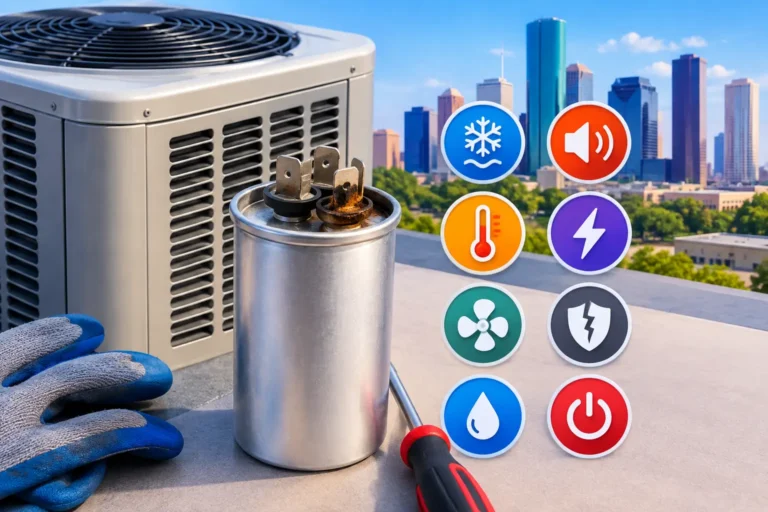
- The control board. Modern systems are full of electronics, and electronics are what surges hurt first. Variable-speed and inverter equipment, including mini splits, carry more of them than older single-stage units.
- The compressor windings. A surge can weaken the winding insulation without killing the unit outright. The system keeps running, a little worse each week, and fails months later in a heat wave. That delay is why almost nobody connects the failure to the storm.
Add a Houston summer of afternoon thunderstorms, hurricane season on top, and the outages the area has lived through in recent years, and the exposure adds up.
Two kinds of protection, and why you want both
| Whole-home (at the panel) | Equipment-level (at the unit) | |
|---|---|---|
| Where it goes | Main electrical panel | Condenser disconnect and air handler |
| What it stops | Big external surges from the utility line and storms | Smaller surges that get past the panel device or start inside the house |
| What it protects | Everything in the house | Your HVAC system specifically |
| Weak point | Lets some energy through | Can’t handle a big hit on its own |
The pair is what actually protects an HVAC system. A panel device alone leaves a gap. An equipment device alone is holding back a flood with a towel. If you already have a whole-home device from an electrician, adding the equipment side is a small job.
The $400 upsell question
A case that made the rounds among Houston homeowners: a system only seven months old, and the service tech offered three add-ons. A surge protector for $400, a hard start kit for $340 and a UV light for $1,350. The homeowner asked, reasonably, whether any of it was needed on equipment that new.
Our honest read: of the three, the surge protector is the one that earns its place in Houston. It protects the most expensive parts of the system from a risk that is real here every summer. The price you will see quoted varies with the device and the install, so compare, but the item itself is sound.
The other two are a different story. A hard start kit fixes a compressor that struggles to start. On a seven-month-old system with no starting problem, it is a solution looking for a problem. A UV light can make sense in specific air quality situations. It is not something a new system needs by default. If a quote stacks add-ons on a new unit, ask what problem each one solves in your house. Our guide to shopping without getting upsold goes further.
The one that catches people out
We got a call this year from a customer whose surge protector Koolpro had installed. It worked for years. Then another company replaced her equipment and didn’t reconnect the surge protector properly. It was still on the wall. It just wasn’t protecting anything.
Nobody did anything dramatic wrong. Replacing an outdoor unit means disconnecting the wiring at the disconnect box, and the surge protector’s leads are part of that wiring. Put the new unit in, reconnect the essentials, and the add-on is easy to leave hanging. The system cools, the homeowner signs off, and the gap stays hidden until the next storm.
It is an easy thing to miss on a replacement, and invisible from the ground. If anyone has worked on your system recently, that connection is worth verifying. It costs little to check, and it is the difference between a device that protects a compressor and one that decorates a wall.
They wear out, and they do it silently
A surge protector works by absorbing energy, and each surge uses up part of its capacity. After enough hits it is a dead box that still looks fine.
Most have an indicator light or a small window showing whether they are still live. Checking takes seconds, and it is on our maintenance checklist for that reason. If yours has been through several Houston storm seasons and nobody has looked at it, assume nothing. A service agreement puts that check on the calendar so you don’t have to remember it.
After a storm or an outage
- When the power goes out, set the thermostat to OFF. Not a few degrees up. Off. When power returns, the supply can be unstable for a few minutes and you don’t want the compressor starting into that.
- Wait about 30 minutes before turning it back on. Let the supply settle.
- Never restart a unit that has been under water. Flooded equipment needs an inspection before it gets power again.
- Look at the indicator light on your surge protector once things are back.
If long outages worry you more than flickers, Koolpro also installs backup generators. That is a bigger decision and a different conversation, but worth having if you’ve sat through a multi-day outage in July.
What surge protection won’t do
It won’t save a system from a direct lightning strike, a flood or years of skipped maintenance. It won’t fix a compressor that is already damaged. And it is not a reason to skip checking what your warranty says about electrical damage. On systems Koolpro installs, you get 12 years of manufacturer parts coverage, with labor separate. Protecting the equipment still costs far less than finding out what a claim does and doesn’t cover.
Frequently asked questions
Is an HVAC surge protector worth it in Houston?
Yes. With frequent storms, hurricane season and outages, it is one of the few add-ons we recommend without hesitation. It protects the control board and compressor, the most expensive parts of the system.
Do I need one if I have a whole-home surge protector?
A whole-home device handles large external surges but lets some energy through. Adding protection at the equipment closes that gap.
How do I know if my surge protector still works?
Check its indicator light or status window. If it shows a fault or nothing at all, it needs replacing. Have it checked after storms and after any equipment work.
Should I buy a hard start kit and UV light with a new system?
Not by default. A hard start kit solves a starting problem, and a UV light fits specific air quality needs. Ask what problem each one solves in your house.
If you don’t know whether your system has surge protection, or whether the one you have is still alive, ask us to check it or call 713-714-0707. We serve Houston, Katy, Sugar Land and Fort Bend.