Houston gets its first real cold front sometime between mid-October and November. When it arrives, thousands of heating systems in Katy, Sugar Land and the rest of Fort Bend start up the same week after sitting idle since February. That first start is when the problems that have been waiting all year show up. A fall HVAC tune-up done a few weeks earlier is how you find them on a mild afternoon instead of a 40-degree night.
Quick answer: Book your fall HVAC tune-up in late September or early October, before the first front. A real visit covers the heating side (heat exchanger, burners, safety controls, gas or heat pump changeover) and closes out the cooling season (drain, capacitor, refrigerant readings). If a company is done in fifteen minutes and then pitches add-ons, that was not a tune-up.
Why the timing matters more than the price
There are three practical reasons to do this in October and not the week the temperature drops.
- Mild weather buys you time. If the visit turns up a part that needs ordering, you are not living without heat or AC while it arrives. In October, a two-day wait for a flame sensor is a shrug. In the first cold week, it is two nights with space heaters.
- You pick the appointment. The first cold week fills every schedule in Houston. In early October you still choose the time.
- Your AC just ran five hard months. In August the attic above a Katy or Sugar Land ceiling sits at 130 to 140 degrees, and the air handler and ducts up there live in it. Small summer damage (a weak capacitor, a slow drain, a loose connection) turns into a spring breakdown if nobody looks now.
The 12-point fall HVAC tune-up checklist
This is what a real fall visit covers. Print it, or keep it open on your phone when the technician is there. You are allowed to ask which points were done.
| # | Checkpoint | Why it matters in Houston |
|---|---|---|
| 1 | Heat exchanger inspection | A cracked heat exchanger can leak combustion gases, including carbon monoxide, into your air. The most important point on the list. |
| 2 | Burner cleaning and flame check | Eight months of attic dust makes burners light unevenly and waste gas. |
| 3 | Safety controls test | Limit switch, flame sensor and rollout switches are what shut the furnace down when something goes wrong. |
| 4 | Gas connections and pressure | Checked for leaks and correct operating pressure. |
| 5 | Heat pump changeover | For heat pump homes: the reversing valve switches to heating and the auxiliary heat stages correctly. |
| 6 | Thermostat check | Mode, schedule and calibration, so the program matches how you live now. |
| 7 | Electrical connections | Tightened and tested. Loose connections cause a lot of first-front no-heat calls. |
| 8 | Blower motor and wheel | The same blower moves your heat and your cooling. A dirty wheel moves less air all year. |
| 9 | Filter and airflow | A summer of dust restricts the airflow a furnace needs to run safely. |
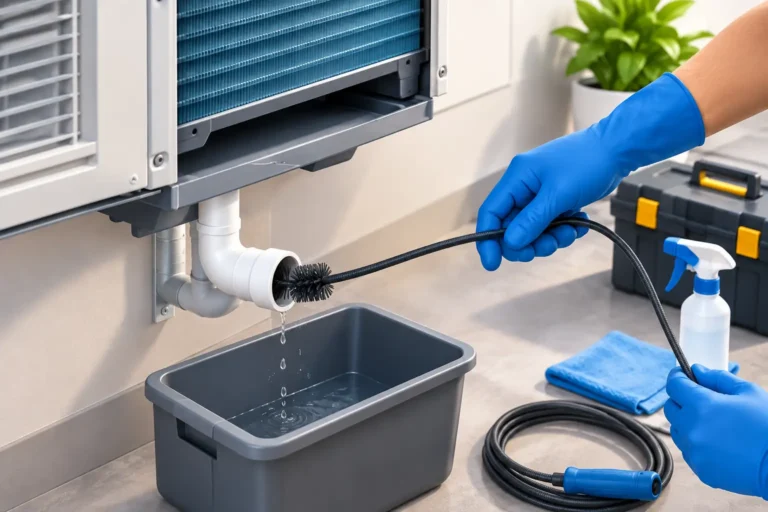
| 10 | Condensate drain | Flushed after a humid summer of nonstop use. Clogged drains are how ceilings get stained. |
| 11 | Cooling-side close-out | Refrigerant readings and capacitor health, so summer wear gets caught now instead of next May. |
| 12 | Carbon monoxide reading | Measured with the heat running. Also a good moment to test your home’s CO alarms. |
Not every point applies to every house. An all-electric heat pump home has no burners or gas line to check, so points 1 to 4 are replaced by a closer look at the heat strips, the defrost controls and the outdoor unit. A newly installed system that never had its setup verified needs something different: that is HVAC commissioning, not a tune-up, and it is worth asking for if your install was rushed.
What a good visit looks like (a real one)
Here is how one of our customers described his annual maintenance visit in a Google review:
“Sebastian with Koolpro came out to do my annual maintenance on my AC. Super professional, knowledgable, polite, and efficient. Absolutely awesome. Highly recommend.” (Mason Rollins)
Notice what he did not write: that he was sold something. “Efficient” is the right word for a tune-up. The technician works through the list, tells you what he found, shows you anything that needs attention, and leaves. If something is wearing out, you should hear it as “this capacitor is reading low, here is the number, it can wait until spring or we can swap it now”, not as a scare.
What you do not need to buy at a tune-up
A fall visit is also when some companies try to make their month. A case that made the rounds among Houston homeowners: a system only seven months old, and the tune-up ended with offers for a surge protector ($400), a hard start kit ($340) and a UV light ($1,350). None of that was a repair. On a seven-month-old unit, the honest answer to all three was “not now”.
Our rule of thumb for what to say no to at a routine tune-up:
- Duct cleaning pitched without showing you dirt or mold inside the ducts.
- Refrigerant “top-offs” with no leak search. If the system is low, it is leaking somewhere. Adding refrigerant without finding the leak means you pay again next year.
- Air quality add-ons when nobody in the house has a complaint. They help in specific cases, not by default.
- Replacing a working system because of its age alone. Age is a planning signal, not a verdict.
Some add-ons are worth it in the right house. The point is that a tune-up should end with a clear list: what is fine, what is wearing, what is urgent. You decide the rest without pressure.
The first-start smell and other things that are normal
When you run the heat for the first time, a dusty burning smell for the first half hour is normal. It is eight months of dust burning off the heat exchanger or the heat strips. Open a window and let it clear.
Not normal: an electrical or plastic smell, a smell that lasts past the first hour, or a rotten-egg gas smell. For the first two, shut the system off and call. For gas, leave the house and call the gas utility from outside.
Heat pump owners will also notice the outdoor unit going quiet and steaming on cold mornings. That is usually the defrost cycle doing its job, not a failure. We cover what is normal and what is not in the heat pump article coming next week.
One visit or a plan: which is cheaper?
Houston needs two visits a year: cooling checked before summer, heating checked before the first front. If you already book both, a service agreement just puts them on a schedule so nobody has to remember. If you only ever call when something breaks, a single fall visit is still worth more than an emergency call in the first cold week.
We are honest about when a plan is not worth it. If your system is brand new and you are disciplined about scheduling, you can book visits one at a time. We walk through the math in are HVAC maintenance plans worth it.
Whatever you choose, keep the paperwork. On systems we install, the manufacturer covers parts for 12 years. Labor is separate. A record of each visit makes any future warranty conversation simpler, and it tells the next technician what has already been checked.
Frequently asked questions
When should I schedule a fall HVAC tune-up in Houston?
Late September through mid-October. The first cold front usually arrives between mid-October and November, and schedules fill fast that week.
How long should a fall tune-up take?
Long enough to work through the checklist, which is well over fifteen minutes on a gas furnace. If the visit is quick and ends with a sales pitch, ask which points were checked.
Do heat pumps need a fall tune-up too?
Yes. The checks are different: reversing valve, defrost controls, heat strips and outdoor coil instead of burners and gas pressure.
Is the burning smell the first time I turn on the heat dangerous?
A dusty smell for the first half hour is normal. An electrical or plastic smell, or anything that lasts past an hour, is not. Turn the system off and call.
Want your system checked before the first cold week fills every schedule? See our seasonal maintenance or book your fall tune-up, or call 713-714-0707. We serve Houston, Katy, Sugar Land and Fort Bend.