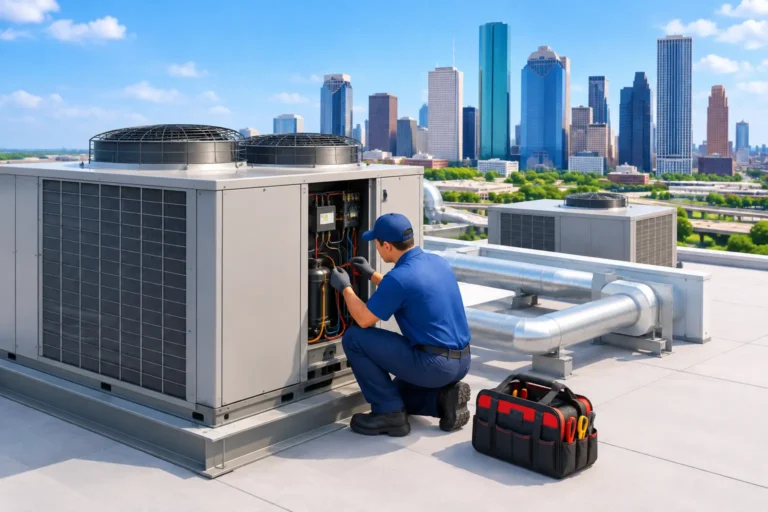

A Houston AC can run for most of the day and still leave upstairs bedrooms muggy, rooms near large windows warm, or a restaurant dining area unevenly cooled. That is usually not just a thermostat problem. To lower cooling costs Houston homeowners and business owners need to look at the full system: equipment condition, humidity, airflow, controls, and the building itself.
The lowest-cost improvement is not always a full system replacement. Sometimes a maintenance visit, duct repair, or better humidity control changes how the space feels and how long the equipment must run. When an older system is undersized, oversized, or nearing the end of its useful life, however, continuing to repair it can cost more than choosing a properly designed high-efficiency replacement.
Start With the Reasons Your AC Runs So Long
Houston heat places a heavy demand on air-conditioning equipment, but high electric bills are often made worse by avoidable issues. Dirty coils, clogged filters, refrigerant problems, weak capacitors, restricted airflow, and leaking ducts can all make an AC work harder to produce the same comfort.
A system that cycles constantly is not automatically too small. It may be struggling with a maintenance issue, pulling hot attic air through leaky ducts, or trying to remove moisture from a home with significant air leaks. On the other hand, a unit that starts and stops frequently may be oversized, improperly controlled, or dealing with an airflow restriction. Both patterns waste energy and add wear to major components.
Before making an expensive decision, have a licensed HVAC professional evaluate operating performance rather than relying on the age of the unit alone. A useful assessment considers refrigerant charge, electrical readings, coil condition, airflow, duct leakage, insulation levels, thermostat operation, and humidity. That gives you a clearer path than replacing equipment based on a high bill alone.
Control Humidity to Feel Comfortable at a Higher Setting
Houston comfort is about temperature and moisture. A home at 74 degrees can feel sticky when indoor humidity is high, while a properly dehumidified home may feel comfortable at a slightly higher thermostat setting. That difference can reduce cooling runtime without asking anyone to tolerate a damp, uncomfortable house.
Your central AC removes some moisture as it cools, but it may not be enough during long humid stretches, especially in larger homes, homes with multiple occupants, or buildings with outside-air ventilation needs. Short cycling and oversized equipment can also limit dehumidification because the system shuts off before completing a longer cooling cycle.
A whole-home dehumidifier is worth considering when humidity routinely remains high even though the AC appears to be cooling. It works alongside the HVAC system to manage moisture more consistently. For commercial spaces, the right solution may involve ventilation adjustments or dedicated outdoor air equipment rather than simply lowering the thermostat.
The trade-off is upfront cost and another piece of equipment to maintain. Still, better humidity control can protect finishes, reduce musty odors, support indoor air quality, and make a more moderate thermostat setting realistic.
Make Airflow and Ductwork Part of the Plan
Conditioned air has little value if it is lost in a hot attic or cannot reach the rooms that need it. Duct leaks, crushed flex duct, poor return-air design, and unbalanced supply registers are common reasons for uncomfortable rooms and higher utility costs.
Pay attention to clues such as a bedroom that never cools, hot spots around the home, excessive dust, whistling vents, or a noticeable temperature difference between floors. Closing multiple supply vents is rarely a smart fix. It can raise duct pressure, reduce airflow across the indoor coil, and create new performance problems.
Duct sealing and targeted repairs can be highly cost-effective when there is measurable leakage or damage. In some homes, adding or improving a return path is just as valuable. Air needs a way to circulate back to the system, particularly when bedroom doors are closed.
For spaces with persistent temperature differences, zoning may be the better long-term answer. HVAC zoning uses separate thermostats and controls to direct cooling where it is needed. Ductless mini-splits can also solve comfort problems in additions, garages, converted rooms, server rooms, and areas where extending ductwork is impractical. These solutions cost more than a basic repair, but they avoid overcooling the rest of the building to satisfy one difficult space.
Use Your Thermostat Without Making Comfort a Daily Argument
A programmable or smart thermostat can help, but only when its schedule matches how the building is used. Setting the temperature far below the desired comfort level will not cool the space faster. It only encourages longer runtime and can create an unnecessarily cold, humid cycle of adjustments.
For a home, modest temperature changes during sleeping hours or when the house is empty can reduce energy use. Avoid dramatic setbacks during a short daytime absence in peak summer weather. The system may need a long, expensive recovery period, and high indoor humidity can make the return uncomfortable.
Commercial settings require the same practical approach. Restaurants, retail spaces, offices, and multifamily properties benefit from schedules that account for occupancy, kitchen heat, operating hours, and fresh-air needs. A thermostat in the wrong location, such as near a kitchen, exterior door, or direct sun, can cause poor decisions throughout the building.
Keep Up With Maintenance Before Summer Exposes a Problem
Seasonal maintenance does more than prevent surprise breakdowns. It helps preserve efficiency when the system is under its greatest load. Filters should be checked regularly, especially with pets, renovation dust, or high occupancy. A blocked filter restricts airflow, which can reduce comfort and strain the blower and compressor.
Professional maintenance should include inspection and cleaning where needed, electrical testing, drain-line checks, airflow review, and confirmation that the system is operating within manufacturer specifications. An indoor coil or outdoor condenser coil does not need to look completely blocked to lose efficiency. Even a buildup of debris can affect heat transfer.
Maintenance cannot make an obsolete unit perform like new, and it will not correct a poor original installation. It does provide the information needed to decide whether a repair is sensible or whether replacement planning should begin before the next major failure.
Choose Replacement Equipment Based on Design, Not the Box
When replacement makes financial sense, efficiency ratings matter, but proper sizing and installation matter just as much. A high-efficiency system installed without a load calculation, correct airflow, properly sized ductwork, or careful commissioning may not deliver the savings you expect.
A qualified contractor should assess the home or commercial space instead of selecting equipment solely by the size of the existing unit. Window exposure, insulation, occupancy, ceiling height, kitchen equipment, internal heat loads, and ventilation requirements all influence the right design. For commercial properties with multiple zones and changing occupancy, VRF systems can offer precise zone-by-zone control and strong part-load efficiency. They are not the right fit for every building, but they can be a valuable option where flexible comfort control is a priority.
Ask about available utility rebates and financing before making a final choice. Incentives can improve the economics of higher-efficiency equipment, ductless systems, heat pumps, or other qualifying upgrades. Koolpro can help customers review tailored options, including potential rebate opportunities, rather than treating every replacement as a one-size-fits-all project.
Small Building Improvements That Support Your HVAC System
Your AC is only one part of the cooling equation. Solar heat through windows, poor attic insulation, unsealed penetrations, and gaps around doors can steadily add to the system’s workload. Window coverings on sun-facing glass, weatherstripping, attic air sealing, and appropriate insulation improvements can reduce heat gain before the AC has to fight it.
These upgrades should be prioritized based on the building. A well-insulated home with severely leaking ducts needs ductwork attention first. A business with frequent door traffic may benefit more from airflow management and equipment controls than from window treatments. The best answer depends on where heat and humidity are entering, and how the space is actually used.
Lower cooling bills should not require sacrificing the comfort that makes a Houston home or business usable in August. Start with an honest evaluation of system performance, address the problems that are forcing unnecessary runtime, and invest in upgrades that solve the specific comfort issue you live or work with every day.