
An HVAC inspection before buying a house is the one check most Houston buyers skip, because they assume the general home inspection already covered it. It did, in the way a general inspection covers everything: wide and shallow. The inspector checks the roof, the foundation, the panel and the plumbing. When they reach the AC, they turn it on, wait, feel a vent, write “appears operational” and move on.
Ten minutes of running proves the system starts. It does not prove it works. In a city where the AC is the most expensive mechanical system in the house, that gap is worth real money.
Quick answer: A real HVAC inspection before buying a house measures the system under load: refrigerant pressures, temperature split, capacitor and amp readings, heat exchanger, ducts and drain. It is worth booking during the option period on any Houston house with a system over roughly 10 years old, or any system with no service records. Use what it finds to negotiate, not to panic.
How an AC passes in April and dies in June
A case that made the rounds among Houston homeowners goes like this. A buyer closed on a house in the spring. The general inspection said the AC was working, and on a mild day it was. The first real heat came, the system ran for a few hours and the compressor quit. It had been on its way out for a while. Nobody had asked it to do anything hard.
No one lied for that to happen. A tired compressor can start and run on a 72-degree day and fail the first afternoon it has to hold 76 inside against 98 outside with Gulf humidity on top. A system low on refrigerant still blows cool air for ten minutes. A weak capacitor still starts the motor, until the day it does not.
The buyer’s position after closing was the worst one available. The seller had disclosed nothing they knew about. A home warranty bought at closing may exclude conditions that existed before the policy started, and proving when a compressor began to fail is close to impossible. The time to find a problem is before you sign, when it costs the seller something and not you.
What a general inspection checks vs. what an HVAC check measures
This is not a criticism of home inspectors. They are generalists by design, and most of them will tell you to get a licensed HVAC contractor to look closer. Here is the difference in practice.
| Item | Typical general inspection | Dedicated HVAC inspection |
|---|---|---|
| Cooling | Turns it on, feels a vent | Measures temperature split and refrigerant pressures under load |
| Electrical | Visual look at the disconnect | Tests capacitors against spec, checks the contactor, compares amp draw to the nameplate |
| Age | Sometimes notes it | Decodes the serial number and checks the refrigerant type |
| Furnace | Confirms it fires | Inspects the heat exchanger and burners for cracks and bad combustion |
| Ductwork | Notes visible damage | Looks at connections, insulation, crushed runs and leaks in the attic |
| Drainage | Checks for stains | Tests the condensate line, pan and float switch |
| Airflow | Rarely | Checks airflow room by room |
The ten things a real check looks at
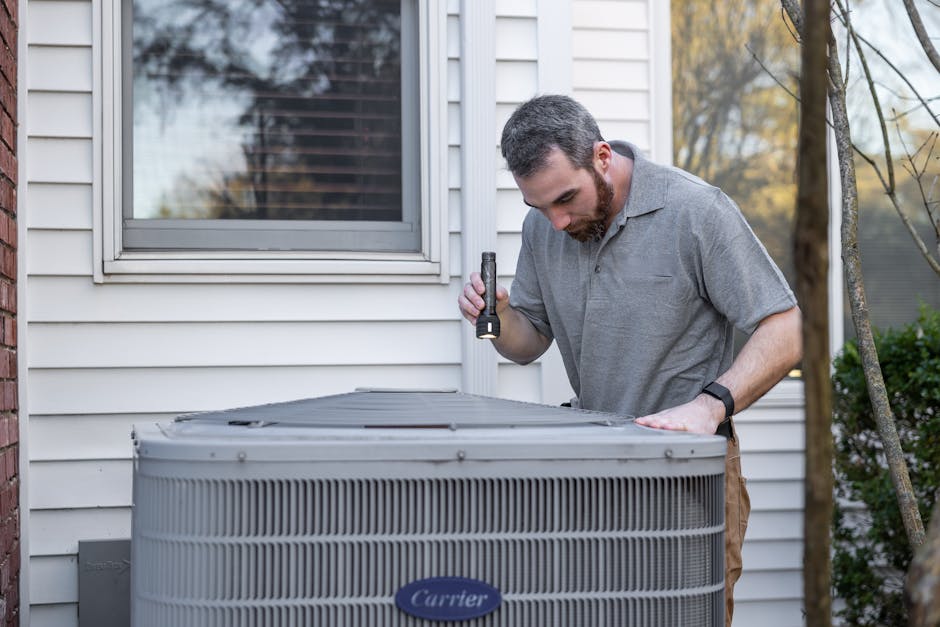
- Age from the serial number. An old system is not a defect. It is a number that belongs in your offer and your budget.
- Refrigerant type. A system on R-22 uses a refrigerant that is no longer produced in the US. Any repair that involves refrigerant gets expensive, and it changes whether repairing is even sensible.
- Refrigerant pressures under load. Not “is it cold” but “is the charge right while the system works.” Low charge usually means a leak somewhere.
- Temperature split. The difference between return air and supply air. It is the fastest honest read on whether the system performs.
- Capacitors, contactor and amp draw. A compressor drawing more than it should, or a capacitor well below its rating, is the early sign of exactly the failure in the story above.
- Heat exchanger. On a gas furnace, a crack is a safety issue, not a comfort one. It is invisible unless someone looks.
- Ductwork. Crushed flex, loose connections and worn insulation in an attic that reaches 130 to 140 degrees in August. New equipment on failing ducts is a common and expensive surprise.
- Condensate system. Drain line, pan and float switch. A clogged line is what stains a ceiling a few months after move-in.
- Airflow room by room. A back bedroom that never cools points to a design problem, not an equipment one. Those cost differently.
- Signs of maintenance. Filter, coil condition, service stickers. How a system was treated predicts its remaining life better than age alone.
When the check is worth it, and when you can skip it
We would rather tell you when not to spend money, so here it is.
Book one if the system is past about 10 years, if the seller has no service records, if the house sat empty, if the inspector flagged anything at all, or if the house has more than one system and you cannot tell which serves what.
You can probably skip it if the equipment is only a few years old, the seller hands you registration and maintenance paperwork, and the general inspector found nothing. In that case, spend the money on a proper seasonal tune-up after you move in instead.
Timing matters in Texas. The option period in a standard contract is short, so call early. The check itself does not need weeks. Getting on the calendar during a busy week sometimes does.
What to do with the report
Most reports are reassuring. You buy the house with one less unknown. When the report is not reassuring, you have something specific and documented, which is a much stronger position than a line that says “appears operational.”
- Weak capacitor, dirty coil, clogged drain. Cheap fixes. Ask the seller to handle them or take a small credit. Do not walk away from a house over them.
- Refrigerant leak or failing compressor on an older system. This is a negotiation item. Price the replacement, not the patch, because patching an old R-22 system rarely makes sense. Our guide on when to replace an air conditioner walks through that math.
- Bad ducts. Ask for a separate number. Ducts are often left out of equipment quotes, and a buyer who budgets for a new system and forgets the ducts gets surprised twice. See ductwork replacement signs and costs.
- Cracked heat exchanger. Do not negotiate around safety. It gets fixed or replaced before you move in.
One honest warning. An old system that tests well is not a reason to demand a full replacement credit. Plenty of 12 and 14 year old systems in Houston have years left. Using age alone as leverage can sour a deal over a system that did nothing wrong. Use measurements, not birthdays.
Reading a replacement quote during the option period
If the seller agrees to replace the system before closing, be careful. A seller who is leaving has every reason to choose the cheapest bid, and you are the one who lives with it. Ask for the model numbers, the SEER2 rating, whether the ducts and the coil are included, who registers the equipment for warranty and in whose name. Our breakdown of what an HVAC quote does not tell you lists the lines to look for.
If you would rather take a credit and choose the installer yourself, that is often the better deal, even at a slightly lower number.
If you are the seller
The same check works in reverse. Knowing the condition of your system before the buyer’s inspector finds it lets you fix, disclose or price it on your terms, instead of renegotiating under deadline. A cleaned coil, a new capacitor and a service record in a folder make a buyer’s inspection go quietly.
Frequently asked questions
Is a home inspection enough to check the AC?
Usually not. A general inspection confirms the system turns on and cools for a few minutes. It rarely measures refrigerant pressures, capacitor values or amp draw, which is where most expensive failures show up first.
When should I schedule an HVAC inspection before buying a house?
Early in the option period, right after the general inspection or alongside it. That leaves time to get a repair or replacement number and negotiate before the deadline.
Can an HVAC inspection be done in winter?
Yes, but cooling tests are limited when it is cold outside. A good technician can still check electrical components, heat, ducts, drainage and system condition, and will tell you plainly what could not be tested.
Should I ask for a new AC just because the system is old?
Not on age alone. Ask for repairs or credits based on what the measurements show. An older system that tests well can have years left, and a newer one with a leak can be the bigger problem.
Before you sign
A pre-purchase HVAC check costs a small fraction of a compressor. If you are buying in Houston, Katy, Sugar Land or Fort Bend and the option period is running, send us the address, the age of the house and your deadline, or call 713-714-0707. We will tell you what we find, including when the answer is that the system is fine and you should keep your money.