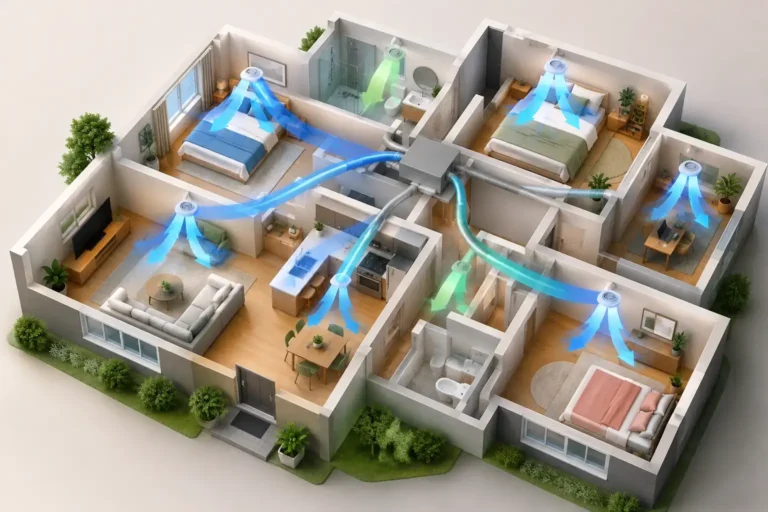
“William, which thermostat should I buy?” It is one of the questions our owner gets most, and he never answers it with a brand. He answers with three questions of his own. If you are wondering which thermostat should I buy for a Houston home, those three questions will get you to the right type faster than any review list. Then there are three situations where the type matters less than whether the thermostat fits your system: heat pumps, zoned homes and humidity.
Quick answer: If you set one temperature and rarely touch it, a basic thermostat is enough. If your days follow a routine, a programmable one saves money without effort. If you want control from your phone or travel often, go smart. Before you buy, confirm it works with your system: heat pumps, zoned homes and whole home dehumidifiers all need compatible thermostats.
The three questions we ask before recommending one
These are the same questions William asks a homeowner standing in front of the old thermostat:
- Do you want to see and change it from your phone? Some people love checking the house from the office. Others never want another app.
- Do you set one temperature and forget it, or change it all day? Be honest. Many people buy a smart thermostat and leave it at 74 forever.
- Are you away from home a lot, or on vacation often? An empty house is where scheduling and remote control pay off.
Your answers point to one of three types.
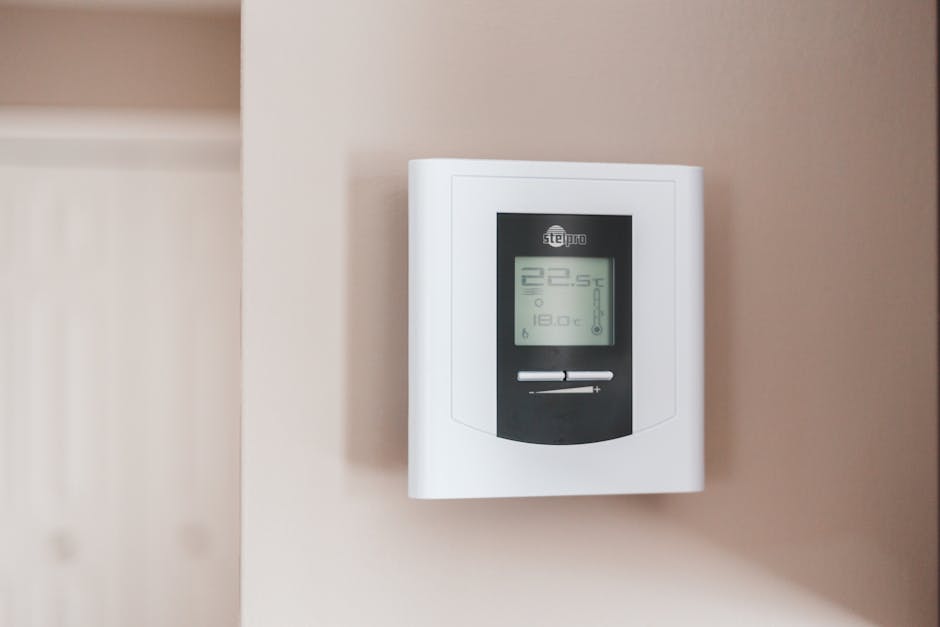
Basic, programmable or smart: what each one is for
| Type | Best for | Skip it if | Typical installed cost |
|---|---|---|---|
| Basic (non programmable) | Set it and forget it households, rentals, someone home all day | The house is empty most of the day | Lowest. Often under $150 installed |
| Programmable | Regular weekly routines: work, school, weekends | Your schedule changes every week | Roughly $100 to $300 installed |
| Smart (Wi-Fi) | Phone control, travel, irregular schedules, energy reports | You never want an app or your Wi-Fi is unreliable | Roughly $185 to $600 installed, more if new wiring is needed |
The cost ranges are national averages and depend on the model and your wiring. The most common surprise with smart thermostats is the C wire: many need a constant power wire that older Houston homes do not always have at the thermostat. It can be added or worked around, but it is a reason to check before you buy.
Our honest take: if your answers were “no app, one temperature, home most of the time,” do not let anyone sell you a smart thermostat. Spend that money on a tune-up. A smart thermostat saves energy by changing the temperature when nobody is home. If nobody ever changes it, there is nothing to save.
One more thing about saving energy. The savings come from raising the setpoint a few degrees when you leave, not from switching the AC off. Turning it off in a Houston summer means coming home to a hot, humid house that the system then has to fight for hours. We explain why in the energy saving myths we hear most.
Have a heat pump? This matters more than the brand
Heat pumps are common in Houston homes, and they are the case where the wrong thermostat costs real money. A heat pump thermostat has to control a reversing valve to switch between cooling and heating, and it has to manage the backup heat strips (often called auxiliary or emergency heat).
When the thermostat is not set up for a heat pump, or is set up wrong, the backup strips can kick on far more than they should. Those strips are the most expensive way to heat a home, and on a cold front in January they can make a heating bill jump. Look for:
- Explicit heat pump support on the box, including auxiliary heat.
- A setting that limits backup heat to very cold outdoor temperatures, when the thermostat supports an outdoor sensor or weather data.
- An installer who sets the heat pump options, not just mounts the device.
If you are still deciding on the system itself, our heat pump installation page explains how they work in a Houston climate.
Zoned home? Not every thermostat talks to a zone panel
A zoned system uses one thermostat per zone, usually upstairs and downstairs, connected to a zone control panel that opens and closes dampers in the ducts. The thermostat does not talk to the AC directly. It talks to the panel.
That changes the buying question. Some smart thermostats work well with zone panels, others lose features or simply do not work. Before replacing one thermostat in a zoned home, find the zone panel (often near the air handler in the attic) and check the brand and model. Replacing all zones with the same family of thermostat usually avoids headaches.
If one room is hot no matter what the thermostat says, the thermostat is probably not the problem. Read why one room is always hotter than the rest, or see how residential zoning fixes it.
Fighting humidity? Look for humidity control
In Houston, comfort is as much about humidity as temperature. A house at 75 degrees and 65 percent humidity feels worse than one at 77 and 45 percent. Most comfort and mold guidance aims for indoor humidity between 30 and 50 percent.
Some thermostats show indoor humidity, and some can do more:
- Display only: useful to know where you stand.
- Dehumidify with the AC: runs the AC a little longer or slower to pull more moisture.
- Control a whole home dehumidifier: turns a dedicated dehumidifier on when humidity climbs, even when cooling is not needed, which is common in spring and fall here.
If your house feels clammy even when the temperature is right, a thermostat with humidity display is a cheap way to confirm it, and a whole home dehumidifier is often the real fix.
Where the thermostat goes matters too
The third question we ask on every service visit is where your thermostat is and what temperature you like. A great thermostat in a bad spot gives bad results. Avoid:
| Bad location | What goes wrong |
|---|---|
| In direct sun or near a window | It reads hot and overcools the rest of the house |
| Right under a supply vent | It feels the cold air first and shuts the system off early |
| Next to the kitchen | Cooking heat makes the AC run harder for the whole house |
| On an exterior wall | The wall temperature skews the reading |
| In a room you rarely use | The house is comfortable where nobody is |
A hallway near the center of the house, on an interior wall, is usually the best spot.
Frequently asked questions
Which thermostat should I buy if I rarely change the temperature?
A basic or simple programmable thermostat. A smart thermostat only saves money when the temperature changes while you are away. If you leave it at one setting, the extra cost rarely pays back.
What is the best thermostat for a heat pump?
Any quality thermostat that clearly supports heat pumps with auxiliary heat, set up correctly. The setup matters more than the brand, because a wrong setting can run the expensive backup heat strips too often.
Do I need a smart thermostat for each zone?
Each zone needs its own thermostat, but it does not have to be smart. What matters is that every thermostat is compatible with your zone control panel.
Can I install a thermostat myself?
A like for like swap on a simple system is a common DIY job. Heat pumps, zoned systems and thermostats that need a new C wire are where a mistake gets expensive, and where we recommend a professional install.
Want a second opinion before you buy, or help installing it on a heat pump or zoned system? Contact Koolpro or call 713-714-0707. We serve Houston, Katy, Sugar Land and Fort Bend.