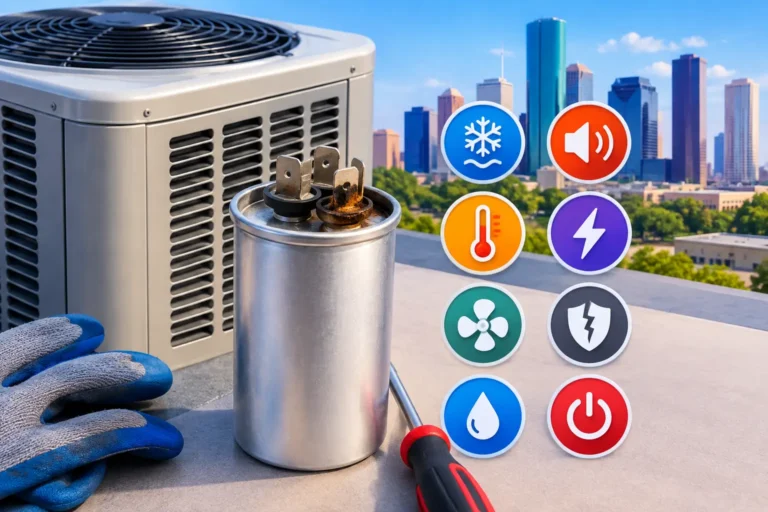
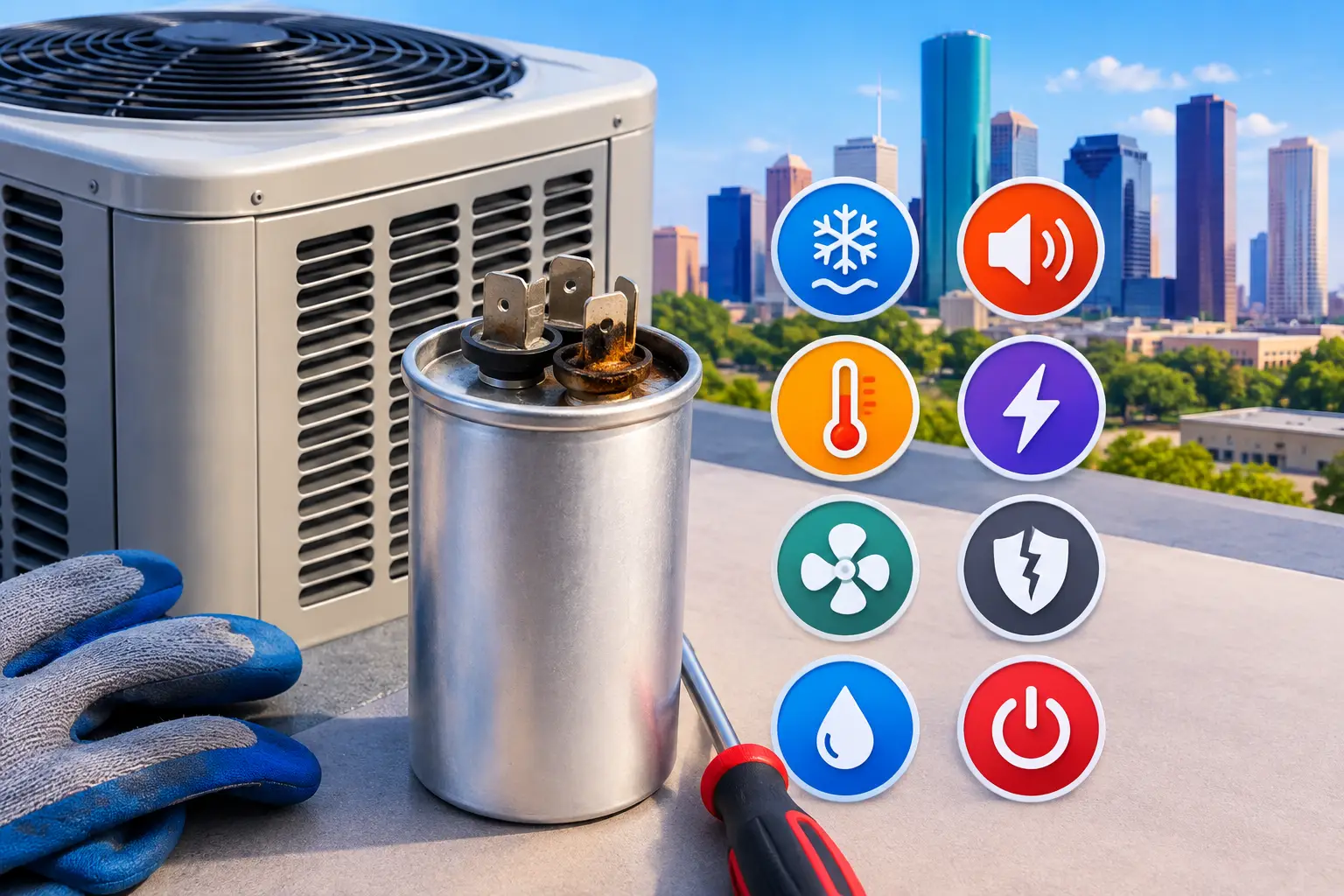
A Houston AC can seem fine in the morning and struggle badly by midafternoon, especially when a weak capacitor can no longer help the system start and run under heavy demand. Knowing the AC capacitor failure signs can help you act before a hot home, uncomfortable tenants, or an interrupted business day turns into a larger repair.
The capacitor is a small electrical component, but it has a major job. It stores and releases energy needed to start the compressor and fan motors, then helps keep them operating efficiently. When it weakens or fails, your air conditioner may still run for a while, but it is working under strain.
What an AC Capacitor Does
Most central air conditioners use a run capacitor, while some systems also use a start capacitor. A dual-run capacitor is common in residential condensers and supports both the compressor and outdoor fan motor. Ductless, heat pump, and commercial equipment may use different electrical configurations, but the basic concern is the same: motors need the correct electrical support to start and operate reliably.
Capacitors wear out over time. Houston heat, long cooling seasons, electrical surges, vibration, and aging equipment can all shorten their useful life. A capacitor problem is often repairable when caught early, but continuing to run the system can place added stress on the compressor or fan motor.
8 AC Capacitor Failure Signs to Watch For
1. Your AC hums but does not start
A humming sound from the outdoor unit is one of the clearest warning signs. The system may be calling for cooling, but the compressor or fan motor may not have enough electrical assistance to start. You may hear the unit hum briefly, then shut off, or it may continue humming without producing cool air.
Turn the thermostat off if this happens. Repeated startup attempts can overheat components and may turn a straightforward capacitor replacement into a more expensive motor or compressor issue.
2. The outdoor fan does not spin
If the outdoor condenser is running but its fan is not moving, the capacitor may be failing. The fan needs to run to release heat from the refrigerant. Without it, the system can overheat quickly.
This symptom can also point to a failed fan motor, damaged wiring, a control problem, or a safety switch. Do not try to spin the fan blade by hand or bypass any electrical component. Outdoor equipment contains high-voltage power, and capacitors can hold a dangerous electrical charge even after the unit is switched off.
3. Cooling starts slowly or only after several attempts
An AC that hesitates before starting is not necessarily having a capacitor problem, but it deserves attention. You may notice a click, a pause, and then a delayed start. On very hot afternoons, the unit may struggle more because electrical and mechanical demand is higher.
A technician can test the capacitor’s microfarad rating and compare it to the manufacturer’s required range. That measurement provides a much clearer answer than judging a capacitor by appearance alone.
4. Your AC turns off before the space reaches the set temperature
Short cycling occurs when an air conditioner starts and stops more often than normal. A weak capacitor can contribute by making it difficult for motors to remain running properly. The issue may also be related to dirty coils, thermostat trouble, refrigerant concerns, airflow restrictions, or an oversized system.
Because several problems can cause short cycling, it is worth getting a professional diagnosis rather than replacing parts based on a guess. The right repair protects both comfort and equipment life.
5. You hear clicking, buzzing, or unusual electrical sounds
A single click during a normal startup can be expected. Repeated clicking, buzzing, or a persistent hum from the outdoor unit is different. It may indicate a component trying unsuccessfully to engage.
Electrical sounds should be taken seriously, particularly in older systems or commercial spaces where equipment runs for extended hours. Shut the system down and arrange service if noises are accompanied by weak cooling, a burning smell, or a tripped breaker.
6. The breaker trips or the disconnect keeps shutting off
A failing capacitor can force a motor to draw more power while trying to start. That extra strain may trip a breaker or trigger safety controls. However, a breaker that trips can also signal damaged wiring, a failing compressor, a grounded motor, or another electrical fault.
Do not repeatedly reset the breaker to keep the AC running. One reset may be reasonable after checking that there is no smoke, odor, or visible damage, but continued tripping calls for a licensed HVAC professional. Repeated resets can create a safety risk and conceal a more serious problem.
7. The system is running, but the air is warm
Warm air from the supply vents does not automatically mean the capacitor has failed. The indoor blower may still operate while the outdoor compressor or fan does not. As a result, air moves through the home or business, but cooling never takes place.
Before calling, check that the thermostat is set to cool and that the filter is not severely clogged. If the outdoor unit is not operating normally, leave further testing to a technician. This is especially important in Houston, where indoor humidity can rise quickly when cooling stops.
8. Your energy bill rises without a clear reason
A weak capacitor can make the AC work harder and run longer, contributing to higher energy use. The increase is not always dramatic, and utility costs can also rise because of hotter weather, poor insulation, duct leakage, dirty coils, or thermostat changes.
Still, an unexplained increase paired with reduced cooling performance is a useful clue. A maintenance visit can identify whether the issue is a capacitor, airflow problem, refrigerant concern, or a system that needs a broader efficiency evaluation.
What a Failed Capacitor Looks Like – and Why That Is Not Enough
Some failed capacitors show visible signs, such as a swollen top, leaking oil, corrosion, or a cracked casing. A healthy-looking capacitor can still be out of specification, though, and a visibly damaged one may be only part of the problem.
Professional diagnosis matters because capacitors must match the equipment’s required rating and voltage. Installing the wrong part can damage the motor, cause unreliable operation, or void equipment protections. A technician will also inspect contactors, wiring, motors, compressor performance, and the electrical supply to make sure the capacitor was the cause rather than a symptom.
What to Do When You Suspect a Capacitor Problem
If your AC is humming, overheating, or failing to start, turn the thermostat off. If you notice burning odors, smoke, a hot electrical panel, or a repeatedly tripping breaker, turn off power to the unit if it is safe to do so and request service promptly.
Avoid the common do-it-yourself advice of using a stick to start an outdoor fan. It can expose you to moving parts and electrical hazards, and it may cause further damage. Capacitors store energy after power is disconnected, so this is not a repair to handle without training and proper testing equipment.
For homeowners, a timely repair can restore cooling and help prevent a stressed fan motor or compressor from failing. For restaurants, offices, and multi-tenant properties, quick diagnosis can also reduce downtime, protect indoor conditions, and avoid disrupting customers or staff.
Preventing Premature Capacitor Failure
No capacitor lasts forever, but routine maintenance can reduce unnecessary strain. Keeping the outdoor unit clear of leaves and debris, changing filters on schedule, maintaining proper airflow, and addressing breaker or startup issues early all help. Seasonal service also gives a technician the chance to inspect electrical connections, test capacitor performance, clean coils, and verify that motors are operating within expected limits.
In Houston’s long cooling season, preventive maintenance is more than a convenience. It is a practical way to catch small electrical issues before peak summer heat puts the entire system under its heaviest load.
If your AC is showing capacitor failure signs, prompt professional testing is the safest next step. Koolpro can identify the source of the problem, explain the repair clearly, and help you make a practical decision for dependable comfort.